
Beginning June 1, Oakland’s Calavera restaurant implemented a significant change to its beverage program. The focus has moved decisively away from mixed drinks. The new calavera restaurant menu reflects a philosophical commitment to agave spirits education and mindful consumption. This shift prioritizes the incredible array of Mexican spirits, specifically the restaurant’s vast collection of mezcals. The primary vehicle for sales is no longer the cocktail, but the spirit served neat. This move is part of a larger conversation about sustainable agave practices. It underscores Calavera’s dedication to quality and mezcal education. The goal is to encourage a culture of neat sipping, appreciating the spirit’s nuance. This commitment is supported by a deep knowledge of Oaxacan spirits and production.
The Audacious Shift: Revising the Cocktail Program
Calavera made a bold move by almost entirely eliminating mezcal cocktails from its standard offerings. Cocktails traditionally represent the “bread and butter” for many bars and restaurants. This is particularly true in a cocktail-focused hub like Oakland. The decision was not driven by ease or profit, but by a higher mission.
The Business Reality of the Decision
From a pure business standpoint, this was a challenging choice. Cocktails are the primary method for introducing and selling mezcal in the American market. They offer high profit margins and fast service. Owner Chris Pastena acknowledged the inherent difficulty. He stated that the cocktail culture often made it hard to conduct proper agave spirits education from the bar.
The business had to adapt to this new model. The operational focus shifted entirely to the back bar. This required a re-evaluation of inventory management and service speed. The long-term gain is built on customer loyalty and higher-value sales of neat pours. It’s a calculated risk in a highly competitive market.
Establishing a Culture of Mezcal Education
The new beverage program is essentially an educational platform. The core belief is that mezcal’s complexity is lost when masked by mixers and sugars. This “lessening mindfulness” of consumption is what Pastena aims to combat. His goal is to promote mezcal’s inherent value as a sipping spirit.
The staff underwent extensive training in preparation for the change. Bartenders and servers must now act as mezcal educators. They guide guests through the collection of 300 bottles. This level of service enhances the customer experience. It also strengthens the restaurant’s E-E-A-T (Expertise, Experience, Authority, Trustworthiness) profile.
The Heart of the Offering: Calavera’s 300-Bottle Mezcal Collection
The true star of the Calavera experience is the expansive back bar. It showcases approximately 300 unique mezcals. These spirits are sourced meticulously from every major producing region across Mexico. The collection is designed to be a living library of agave. It offers a comprehensive view of the spirit’s diversity.
Decoding Production: Ancestral, Artesanal, and Modern
The sheer size of the collection allows for deep exploration of production methods. Guests can compare spirits made using the three official classifications. Ancestral mezcal is made entirely by hand, often crushing the cooked agave with a mallet. Artesanal mezcal allows for the use of certain mechanical mills, but still requires stone ovens and wild fermentation. The third classification, simply “Mezcal,” permits more modern, industrial processes.
This variety highlights how production directly affects flavor. The collection allows for tasting different historical approaches side-by-side. This facilitates genuine appreciation of the craft. It moves beyond simple consumption to intellectual curiosity.
Regional Diversity and Agave Varietals
The collection represents a geographical tour of Mexico’s agave landscape. Oaxaca is the most well-known region, but Calavera offers much more. Spirits from Michoacán, Durango, Guerrero, and Puebla are well-represented. Each region has unique soil, climate, and water sources.
Equally important are the agave species. The menu features ubiquitous Espadín, but also wild varieties. Guests can explore Tobalá, Tepeztate, Cuishe, and Cupreata. Each varietal contributes a distinct flavor profile. Tobalá often presents floral and fruity notes. Tepeztate is known for its vegetal, spicy, and sometimes smoky character.
The Ethical Imperative: Addressing Volume Production Impact
Pastena’s deepening love for mezcal is intrinsically linked to ethical sourcing. He has spent time in mezcal-producing communities. This experience revealed the disruptive impact of high-volume production. Rapid commercialization can strain local resources and exploit labor. It can also lead to the unsustainable harvesting of wild agave.
The restaurant’s shift is a response to this realization. It aims to support smaller, sustainable producers. By focusing on neat sipping, they discourage the use of bulk, low-quality mezcal in cocktails. This choice sends a strong message to the industry. It emphasizes quality, ethics, and sustainability over cheap, mass-produced volume.
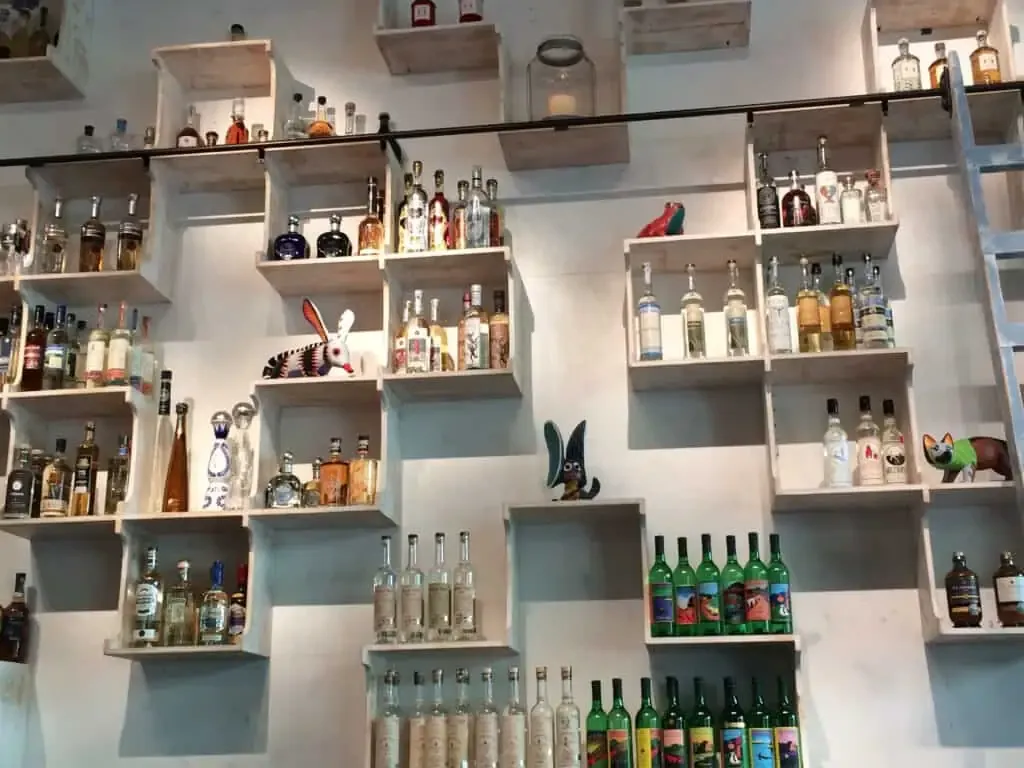 calavera restaurant menu: The back bar displaying the extensive mezcal collection
The Singular Exception: The Mezcalito and La Luna Cupreata
Calavera has retained one lone mezcal cocktail on its calavera restaurant menu: The Mezcalito. This drink serves a critical dual purpose. It provides an option for guests seeking a mixed drink. Crucially, it highlights the complexity of a responsibly sourced spirit.
The cocktail is crafted exclusively with La Luna Mezcal Cupreata. This decision is not random. The Cupreata agave provides a complex, savory flavor. This profile allows the spirit’s nuance to still shine through the cocktail format. It’s an example of a mezcal that works well in a mixed drink without losing its identity.
A Relationship Built on Trust: Visiting the Vinata
Pastena’s commitment to La Luna is rooted in a personal relationship. He has visited the vinata, or distillery, in Michoacán. This firsthand experience reinforces the decision. Knowing the producers and their sustainable practices builds trust. It is the core of the restaurant’s ethical sourcing policy.
This transparency validates the choice for the single cocktail. It’s a spirit the owner trusts completely. This deep connection to the source is a hallmark of the new philosophy. It shows that every product decision is thoughtful and informed.
A Wider Lens on Mexican Spirits
The new focus extends beyond just mezcal. Calavera is dedicated to showcasing the full spectrum of high-quality Mexican spirits. This holistic approach further establishes their authority in this niche. The goal is to be a destination for all authentic Mexican distillates.
Expanding the Spirit Portfolio: Rum, Whiskey, and Gin
The back bar now features a curated selection of Mexican rum, whisky, and gin. Mexican distillers are increasingly making world-class versions of these spirits. By stocking them, Calavera supports this growing movement. It educates guests on Mexico’s diverse distillation heritage.
Mexican rum, often derived from sugarcane, has unique terroir expressions. Mexican whisky, while a newer category, is gaining international acclaim. Even gin, using botanicals unique to Mexico, offers distinct flavors. This variety caters to different palates while maintaining a regional focus.
The All-Mexican Wine List
This dedication to local sourcing extends even to the wine list. Calavera only serves Mexican wine. This is another bold, perhaps unusual, choice for an American restaurant. Mexico’s wine regions, like Valle de Guadalupe, are producing excellent varietals.
The all-Mexican wine list complements the spirits program perfectly. It ties the entire beverage offering back to a unified geographical and ethical concept. It encourages diners to explore the entire breadth of Mexico’s refined culinary and beverage culture.
Owner Chris Pastena: A History of Calculated Risk
The bold shift at Calavera is consistent with owner Chris Pastena’s operational history. He has a track record of making principled, risk-taking decisions in the restaurant business. These past actions establish his expertise and conviction. They show that this mezcal decision is part of a larger philosophy.
Precedent at Chop Bar: Wine-on-Tap
Pastena’s first Oakland venture, Chop Bar, demonstrated his willingness to challenge norms. Over 13 years ago, he decided to only serve wine on tap. This was well before the practice gained widespread acceptance. The decision was initially practical, due to limited space. It quickly became a hallmark of the restaurant’s innovative character.
This precedent shows an operational courage. It proves Pastena is willing to endure initial skepticism for a long-term vision. He prefers standards and ethics over following conventional wisdom.
The Jack Daniels Analogy: Sustainability Standards
Another key decision at Chop Bar was the refusal to carry Jack Daniels. Instead, Pastena opted for bourbons and whiskeys with better operating and sustainability standards. This was not an act of pretense. It was an early indication of his commitment to ethical sourcing and responsible business practices.
This history directly informs the current mezcal decision. The new program is a higher-stakes version of the same principle. It chooses transparency and sustainability over easy cocktail profits. This consistency adds depth to the Calavera brand’s credibility.
Sparking an Industry Conversation
The primary motivation for this change is to spark a larger industry dialogue. Pastena believes the overabundance of mezcal cocktails leads to a lack of respect for the spirit. By limiting the offering, he forces customers and competitors to rethink mezcal’s role. He is challenging the hospitality industry’s reliance on “well mezcal” that loses its nuance in a mixed drink.
The Single Malt Scotch Parallel
Pastena draws a clear parallel to the world of single malt scotch. Many high-end bars feature an incredible selection of scotch on the back bar. However, they rarely, if ever, feature a scotch cocktail on the menu. Scotch is universally respected as a sipping spirit.
He poses the question: “Why can’t we do that with mezcal?” Mezcal possesses the same complexity, history, and craft as fine scotch. Calavera is trying to establish mezcal’s place in that same category of revered, neat-sipping spirits. This elevates the spirit’s status and the bar’s service level.
Staff Expertise and Enhanced Service
The staff training is critical to this conversation. They must be able to articulate the difference between a Cupreata and a Tobalá. They must explain the impact of sustainable harvesting. This expertise enhances the entire service experience. It moves the interaction from transactional to educational. This highly informed service further justifies the premium pricing and philosophical shift. It supports the core belief that customers crave an authentic, knowledgeable experience.
The restaurant will, however, accommodate specific customer requests. If a guest asks for a classic cocktail, like a Mezcal Negroni, the staff will gladly prepare it. This ensures hospitality remains paramount. The emphasis is on education and suggestion, not rigid refusal.
The ambitious shift at Calavera, centered around the new calavera restaurant menu, is more than a simple menu update. It is a profound philosophical statement. Owner Chris Pastena has leveraged his history of calculated risk to champion a new era of mindful consumption. By drastically cutting mezcal cocktails, he forces attention onto the 300-bottle back bar. The focus is now on neat sipping, staff mezcal education, and supporting sustainable agave practices across Mexico. This decision elevates the entire category, pushing the industry to treat mezcal with the respect and integrity it deserves, much like single malt scotch. It is an authoritative move that firmly establishes Calavera as a premier destination for Oaxacan spirits and ethical Mexican distillation.
Last Updated on November 21, 2025 by Alex Cesaria

Alex Cesaria is the creative force behind Nomad Girl, an all-day café and ristorante with a signature Milanese flair located in the heart of Nomad, New York City. With years of experience in the hospitality industry, Alex blends refined Italian sensibilities with New York’s energetic dining culture to create a place that feels both elegant and welcoming.